
Decision Guide
When should you rewire an older home?
How to tell when an older Pennsylvania home needs rewiring: knob-and-tube, cloth and aluminum wiring, warning signs, partial vs. full rewires, insurance, and costs.
Rewiring makes sense when much of the house still runs on knob-and-tube or brittle cloth-insulated wiring, when you see warning signs like warm outlets or frequent trips, when walls are open for a remodel, or when an insurer requires it. Angi puts rewiring at about $2 to $4 per square foot, plus wall repair.
Published 2026-10-11 · Updated 2026-10-11
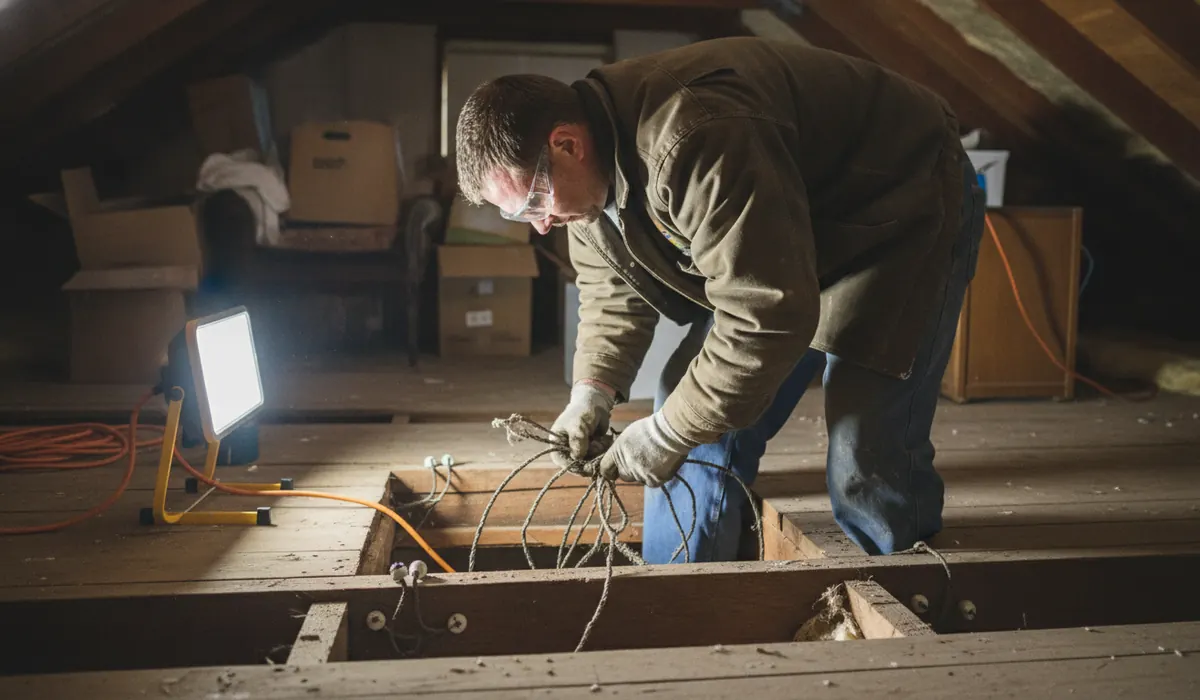
Why this question comes up so often in Pennsylvania
Pennsylvania’s older cities are full of century-old houses. According to the U.S. Census Bureau’s 2020–2024 American Community Survey, homes built before 1940 make up 57 percent of the housing in Reading, 54 percent in Lancaster, 49 percent in York, 43 percent in Harrisburg, and 38 percent in Allentown. Very few of those still have only their original wiring. Most have been rewired in pieces, which is exactly what makes them hard to judge from the outside.
The wiring types you might find
| Wiring | Era (roughly) | The concern |
|---|---|---|
| Knob-and-tube | Before about 1940 | No ground; brittle insulation; designed to shed heat into open air, so it shouldn’t be buried in insulation; often extended with later splices |
| Cloth-sheathed cable | About 1930s–1960s | Often ungrounded; insulation cracks when disturbed |
| Aluminum branch wiring | Some homes wired 1965 to the mid-1970s | CPSC research found these homes 55 times more likely to have a connection reach “fire hazard conditions” than copper-wired homes |
| Modern grounded copper cable | 1960s onward | Generally fine; problems are usually connections and devices, not the cable |
Sources: U.S. Consumer Product Safety Commission, Repairing Aluminum Wiring.
Signs it’s time to rewire, or at least assess
- Porcelain knobs and tubes or cloth-covered wire visible in the basement or attic
- Two-prong outlets throughout the house
- Outlets, switches, or plates that are warm or discolored, or smell like burning plastic
- Frequent trips or blown fuses, or lights that dim when appliances run
- Brittle, cracked, or rodent-chewed insulation wherever wiring is visible
- A home inspector, lender, or insurer has flagged the wiring
- You’re about to open walls, finish an attic, or add insulation
Partial or full rewire?
You don’t always have to rewire everything at once.
A partial rewire usually makes sense when the house has already been updated in places. Electricians often start with the panel and service so new circuits have room, then replace the highest-risk and highest-load circuits: kitchen, bathrooms, laundry, and anything still on knob-and-tube in an attic that’s being insulated.
A full rewire usually makes sense when most of the house is on original knob-and-tube or brittle cloth wiring, when you’re gutting walls for a renovation, or when an insurer requires it.
For aluminum branch wiring, CPSC lists two permanent fixes: rewiring with copper, or attaching short copper “pigtails” at every connection using connectors designed for the purpose (such as COPALUM crimps or AlumiConn connectors). Ordinary twist-on connectors aren’t a substitute.
What rewiring costs
Angi’s 2026 data puts rewiring at about $2 to $4 per square foot:
| Home size | Typical range |
|---|---|
| 1,000 sq ft | $2,000 – $4,000 |
| 1,500 sq ft | $3,000 – $6,000 |
| 2,000 sq ft | $4,000 – $8,000 |
Opening and repairing walls adds about $4 to $8 per square foot of wall, according to the same source. Plaster and lath, brick party walls, and balloon framing, all common in older Pennsylvania houses, make fishing cable slower and patching more expensive. Panel upgrades are often needed at the same time. See the Pennsylvania electrician cost guide.
Permits, insurance, and living through it
- Permits: rewiring is permitted work under the Pennsylvania Uniform Construction Code, inspected by your municipality or its third-party agency. The electrician normally pulls the permit.
- Insurance: some insurers ask about or limit coverage for active knob-and-tube or aluminum wiring. Ask before you buy, and keep the permit and final inspection paperwork after you rewire.
- Living there: most rewires are done circuit by circuit, so you can usually stay in the house. Ask how long each area will be without power and who patches the walls.
The bottom line on older wiring
Old wiring isn’t automatically dangerous, but it’s old, often ungrounded, and rarely designed for today’s loads. The time to deal with it is before you insulate, remodel, or add major appliances. Start with an assessment of what’s actually in the walls; see house rewiring.
The bottom line
If you need an electrician now, call (717) 409-6059 and we'll try to connect you with a participating independent electrician who serves your area. That electrician diagnoses the problem and quotes the job themselves. If anything is smoking, sparking, or smells like it's burning, leave and call 911 first.